Local Search for Luxury Real Estate Agents Who Want High-End Buyers and Sellers
How SEO, AEO, and GEO work together to help agents get found by affluent buyers and sellers searching Google, Maps, and AI answer engines.

TL;DR
Luxury buyers and sellers research agents quietly before they ever call, often through Google, Maps, and AI tools like ChatGPT. SEO helps you rank in search, AEO helps you appear inside AI answers, and GEO helps you show up for the specific neighborhoods and price bands you serve. Together they put your name in front of high-intent prospects at the exact moment they are deciding whom to trust.
Luxury buyers and sellers almost always research an agent before they reach out, and most of that research now happens in Google, Google Maps, and AI answer tools. SEO gets you ranking in traditional search results, AEO (answer engine optimization) gets your name inside AI answers, and GEO (geographic or generative engine optimization, depending on who you ask) ties your visibility to specific neighborhoods and price ranges. When these three work together, you show up as a credible option at the exact moment a high-net-worth prospect is quietly deciding whom to call.
This guide explains what each one does, why it matters for high-end listings, and where to focus first.
What are AEO, GEO, and SEO in plain terms?

SEO, search engine optimization, is the practice of getting your website and profiles to rank in search results. For an agent, that means showing up when someone types "luxury realtor" plus a city or neighborhood.
AEO, answer engine optimization, is about being cited inside the answers that AI tools like ChatGPT, Google's AI Overviews, and Gemini generate. Instead of a list of blue links, these tools produce a written answer. AEO is how you become one of the sources they pull from.
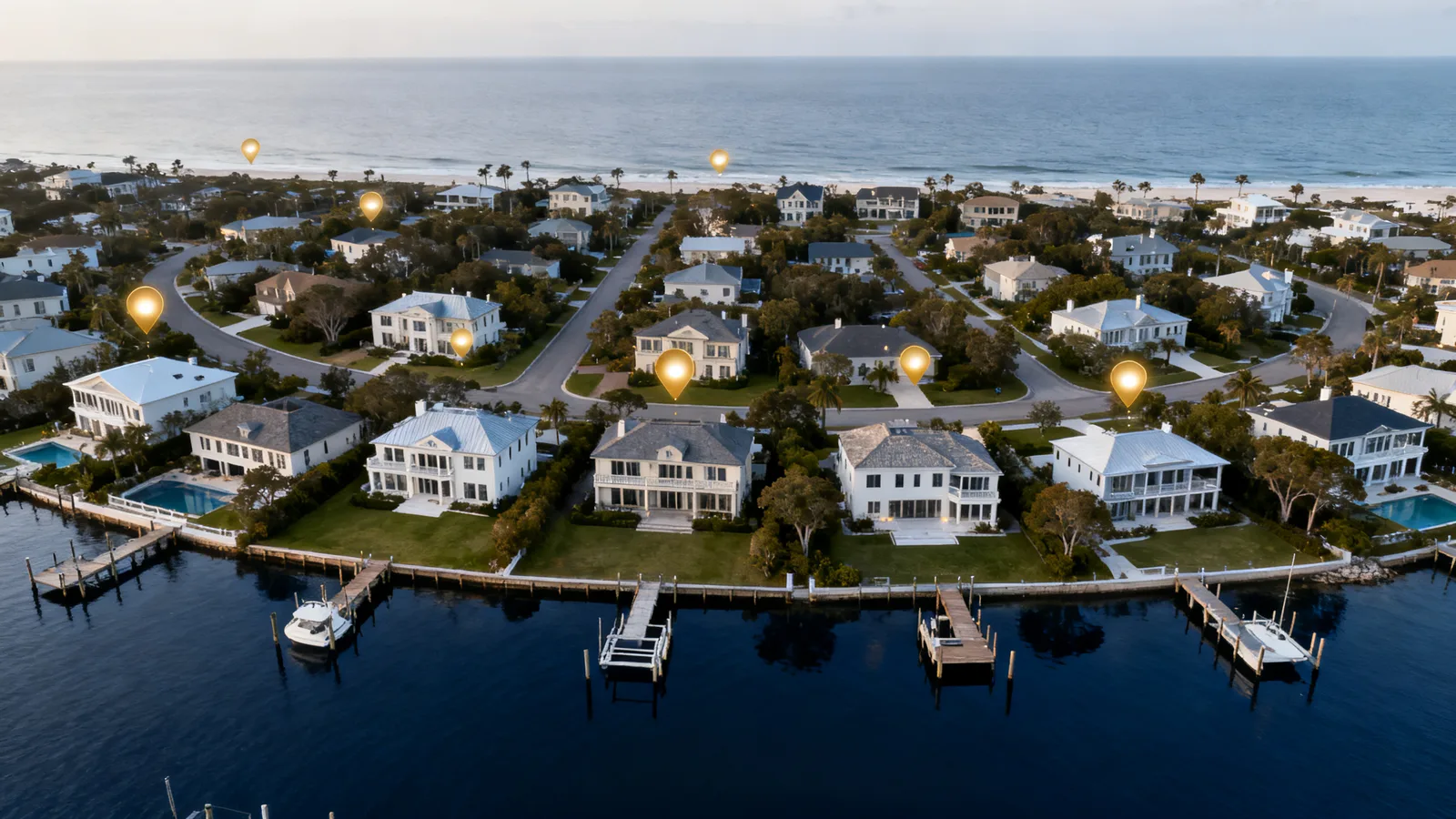
GEO can mean two things, and both matter here. Some use it for geographic optimization, meaning visibility for specific places. Others use it for generative engine optimization, a close cousin of AEO. For a realtor, the geographic angle is the practical one: showing up for the exact enclaves, gated communities, and waterfront streets where luxury inventory sits.
If any of these terms are new, the Glossary has short definitions.
Why does this matter more for luxury real estate than for other homes?
The buying pool is smaller, more private, and more research-driven. A luxury buyer or seller is often making a decision worth millions, and they vet agents carefully before making contact.
That vetting is invisible to you. Someone may read three of your pages, check your reviews, and ask an AI tool "who are the top luxury agents in this area" without ever filling out a form. If your name does not appear during that quiet research phase, you are never in the running.
Luxury searches are also more specific. People do not search "homes for sale." They search a named community, a school district, a waterfront, or a price band. The agent whose content matches those specific queries has an advantage a generic profile simply cannot match.
How does SEO help attract high-end clients?
SEO makes you findable for the searches serious prospects actually type. That starts with a website built around clear, specific pages rather than one catch-all homepage.
A few things carry weight for luxury agents:
- Dedicated pages for each neighborhood or community you specialize in, with real detail about the area.
- Separate pages for sellers and buyers, since their questions differ.
- A Google Business Profile that is complete, accurate, and consistent with your website. Consistency of your name, address, and phone number across the web is a documented ranking factor for local visibility.
- Reviews, which influence both how you rank and whether a cautious prospect trusts you.
None of this is fast. SEO compounds over months, which is exactly why it protects you: a competitor cannot buy their way past a well-built, well-earned presence overnight.
Want this working on your numbers?
Viewmedia makes marketing you can prove, matched to real, closed sales.
How does AEO get your name into AI answers?
AEO works by making your content easy for AI tools to read, quote, and attribute. These tools favor pages that answer a clear question directly and back it up with specifics.
The practical moves are straightforward. Write pages that answer the real questions your clients ask, phrased the way they ask them. Lead with the answer, then explain. Include concrete, verifiable details about the areas and property types you handle. Keep your business information consistent everywhere, because AI tools cross-reference the same signals search engines use.
The payoff: when someone asks an AI assistant for a luxury agent in your market, your name and pages are more likely to appear in the response. Our companion piece on getting cited in AI search answers goes deeper on the mechanics.
One caution: no one can guarantee placement inside an AI answer. Any provider who promises a fixed spot in ChatGPT or Google's AI Overviews is overselling. The honest goal is to become a source these tools consistently prefer.
How does GEO tie you to the neighborhoods that matter?
GEO, in the geographic sense, focuses your visibility on the exact places where your luxury inventory lives. Specificity beats volume here.
A luxury seller wants an agent who clearly knows their street, their community, what comparable homes there have sold for. A page that genuinely covers one named enclave, including its price ranges, property styles, and the lifestyle around it, signals that expertise to both a reader and a search engine.
This also helps you compete against larger brokerages. You may not outrank a national brand for a broad city term, but you can own the specific, high-value communities where you actually work. Depth in a small set of places tends to convert better than shallow coverage of a whole metro.
Where should a luxury agent start?
Start with the basics everything else depends on, then build outward.
- Get your Google Business Profile complete and accurate, and make sure your name, address, and phone match your website exactly.
- Build or improve one strong page for each core neighborhood you serve, written to answer real buyer and seller questions.
- Ask satisfied clients for reviews, steadily and consistently.
- Add a short FAQ to key pages, phrased in your clients' own words. It helps AI tools and human readers alike.
- Keep publishing useful, specific content about your markets rather than generic posts.
You do not have to do all of this at once. A slow, consistent build beats a burst of activity that stops. The agents who show up in six months are the ones who started with the fundamentals and kept going.
What results are realistic, and what is hype?
Realistic results are steady gains in visibility, more of the right inquiries, and a stronger presence when prospects vet you privately. Those improvements build over time and hold because they are earned.
Be skeptical of specific promises. No one can guarantee a Maps ranking, a first-page position, or a spot inside an AI answer, because those systems are controlled by the platforms and change constantly. If you also run consumer email campaigns, Viewmedia does guarantee a 15% open rate, but that is a separate channel from search visibility and should not be confused with ranking claims.
The useful mindset is patience plus proof. Track your inquiries, watch which pages bring them in, and keep investing in the specific, accurate content that both search engines and AI tools reward.
Sources
- Whitespark Local Search Ranking Factors 2026 – expert survey on what drives local pack and organic rankings (Whitespark)
- Google I/O 2024 official announcement of AI Overviews rolling out to all U.S. users (Google Blog)
- GEO: Generative Engine Optimization – arXiv (Aggarwal et al., Princeton/Georgia Tech/IIT Delhi, 2023)
- What is NAP in Local SEO? – BrightLocal
Founder, Viewmedia
Brian Wroblewski is the founder of Viewmedia. For more than two decades he has helped local and regional businesses turn marketing spend into provable, closed sales.