How NAP Consistency Affects Your Local Rankings and AI Answers
Why your business name, address, and phone number need to match everywhere, and how to fix the listings that quietly cost you customers.

TL;DR
NAP stands for your business name, address, and phone number. When those details match across Google, directories, and your own website, search engines and AI tools trust your business more and are more likely to show it. Inconsistent listings split that trust and can leave you out of the Maps local pack and out of AI answers.
NAP consistency means your business name, address, and phone number appear the same way everywhere they're listed online. When those details match across Google, Yelp, your website, and industry directories, search engines treat the listings as one trusted business. When they conflict, that trust splits, and your business can drop out of the Maps local pack or get skipped by AI answer tools pulling from the same data.
This is one of the least exciting parts of local search and one of the most common places small businesses lose ground. The fix is mostly careful, boring work. Here is what to check and why it matters.
What does NAP actually stand for?
NAP stands for Name, Address, and Phone number. Some people add a W for Website and call it NAP+W. These are the core identity details search engines use to confirm a business is real and to tell it apart from similar names.
Google lists consistent, accurate information as a factor in local ranking and prominence in its own documentation (Google Business Profile Help). The logic is straightforward: if a search engine sees the same details repeated across many independent sources, it has more confidence the business exists and operates where it claims.
Why does NAP consistency affect rankings?
Search engines build a picture of your business from mentions across the web. Each mention of your name, address, and phone is called a citation. When citations agree, they reinforce one record. When they disagree, the engine has to decide which version is correct, and uncertainty rarely helps you.
Three problems cause most of the damage:
- Conflicting addresses. An old suite number on one directory and a new one on another. The engine cannot tell which location is current.
- Different phone numbers. A tracking number on your ads, a cell number on Yelp, a landline on Google. Common and easy to let slide.
- Name variations. "Bob's Plumbing" in one place, "Bob's Plumbing & Drain LLC" in another. Minor differences add up.
None of this will hurt you dramatically. The effect is quieter. Your listing competes with less authority than a competitor whose details are clean and consistent.
How does NAP affect AI search answers?
AI answer tools and chat assistants often pull business details from the same structured sources that feed traditional search: business profiles, directories, and your website's markup. If those sources disagree, an AI tool may surface the wrong phone number, an outdated address, or skip your business entirely in favor of one with cleaner data.
Getting cited in AI answers depends heavily on the machine being able to confirm facts about you. Consistent NAP details give it fewer reasons to doubt. If you want to go deeper on this, see our guide on getting your business cited in AI search answers.
Want this working on your numbers?
Viewmedia makes marketing you can prove, matched to real, closed sales.
Where should your NAP information appear?
Start with the places that carry the most weight and work outward.
- Your own website. Put your full name, address, and phone in the footer and on your contact page. This is the one source you control completely.
- Your Google Business Profile. This drives the Maps local pack and many AI answers. See our guide on how to optimize your Google Business Profile so it actually ranks.
- Major directories. Yelp, Bing Places, Apple Maps, and Facebook.
- Industry and local directories. Trade associations, chambers of commerce, and city listings relevant to your work.
The goal is not to appear on hundreds of sites. The goal is for every site you are on to say the same thing.
How do you find and fix inconsistent listings?
Start with an audit. Search your business name in Google and note every listing that comes up. Then search your phone number in quotes, which often surfaces old or duplicate listings tied to a number you no longer use.
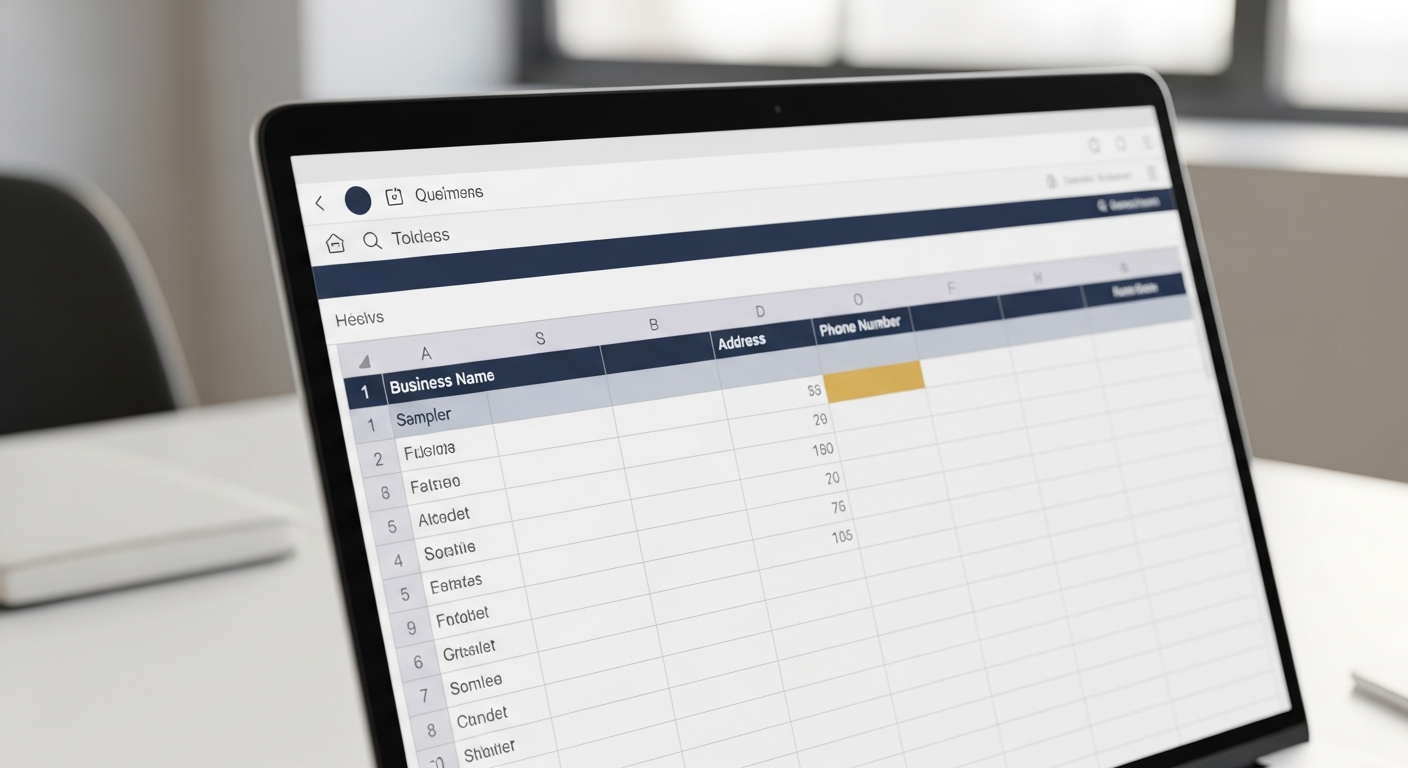
Build a simple spreadsheet with one row per listing and columns for name, address, phone, and website. Flag anything that does not match your website's official version. Then work through the list and correct each one at its source.
A few things to keep in mind:
- Pick one canonical format and stick to it. Decide exactly how your name, address, and phone should read, down to the suite abbreviation, and use that version everywhere.
- Claim duplicates before you fix them. Duplicate Google profiles need to be merged or removed, not just edited.
- Use a consistent phone number. If you rely on call tracking, keep one primary number on your public listings so the data stays clean.
This work takes time and is rarely finished in one sitting. Listings change, old data resurfaces, and new directories pull in stale information. Treat it as periodic maintenance, not a one-time fix.
How often should you check your NAP?
Review your major listings a few times a year, and any time something changes: a move, a new phone number, a name update. After a move especially, plan to update everything quickly. A wrong address is one of the most damaging inconsistencies you can have.
If you change your phone number or business name, expect to spend real effort pushing that change through. Aggregators and directories can be slow to update, and some old records linger for months.
What is the simple takeaway?
Consistent NAP details will not, on their own, put you at the top of the local pack. They are a foundation. Without them, your other efforts, reviews, content, a strong Google Business Profile, all work against unnecessary friction.
Get the basics matching everywhere, keep them current, and you remove one of the most common reasons a search engine or AI tool hesitates to show your business. For more terms used here, see the Glossary.
Founder, Viewmedia
Brian Wroblewski is the founder of Viewmedia. For more than two decades he has helped local and regional businesses turn marketing spend into provable, closed sales.